

Specialized DCS Appliance Repair in San Francisco
Mon–Sat: 8:00 AM – 7:00 PM
One side of the grates scorches while the other barely warms. Learn what causes uneven heat on a DCS grill, which checks are safe, and when to book.
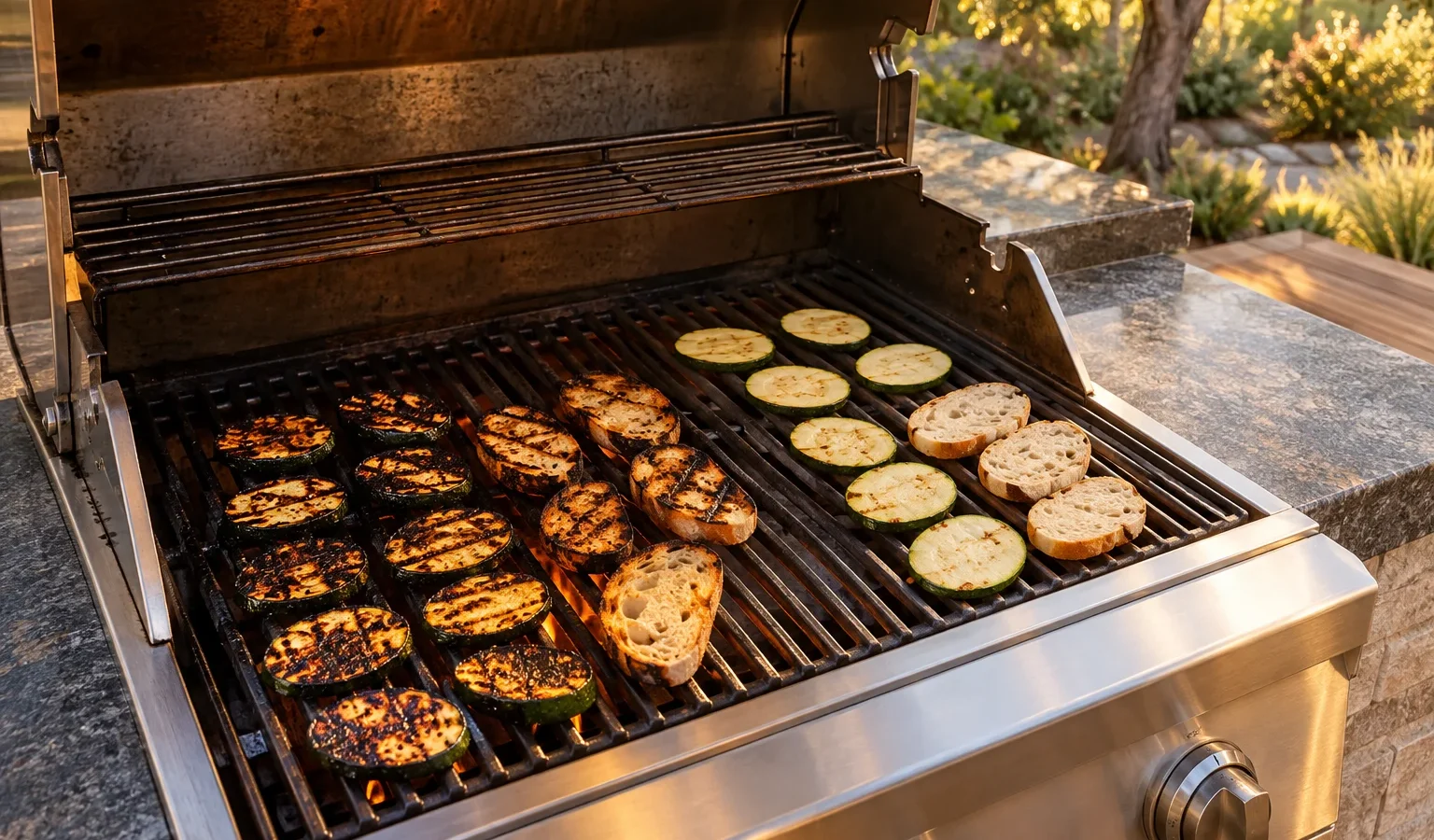
You preheat the grill, lay out the steaks, and discover that the left half sears while the right half merely warms. Uneven heat is one of the most common outdoor grill complaints, and it has more possible sources than people expect. The grates, the burners, the heat distribution plates, the fuel supply and even the wind can each shape the result. Working through them in order tells you whether a clean-up will fix it or whether a technician is needed.
With the lid open and the grates cool enough to see through, light each burner one at a time and watch from a safe distance. A healthy burner shows a steady line of small blue flames along its full length. Gaps, tall yellow flames or flames that lift away from the ports tell you where the unevenness starts. If the burners look good but the heat is still uneven with the lid closed, think about airflow, grease and placement rather than ports.
Grease, food and rust flakes collect in the small ports along the burner tube. Blocked ports starve part of the flame, and the grates above stay cooler. Spiders and mud dauber wasps also nest in burner tubes outdoors and block gas and air; that is common on grills left uncovered in a backyard.
Plates or bars between flame and food spread heat. Heavy residue blocks it and can cause flare-ups. Scraping them clean improves heat evenness considerably.
Propane tanks and natural gas lines must deliver steady pressure. A tank running low, a regulator that has begun to fail, or a partly closed valve causes a general loss of heat, often with the flames at the far end of the burner dying first. The BH1-36-L and BE1-36C-L are named as LPG models in our lineup, while a natural gas model such as the BG48-BQRN carries the N suffix as named. A mismatch between the fuel a grill is set up for and the fuel it is on produces odd flames. Conversions are technician work.
Rooftop terraces and hillside decks in the Bay Area get gusts that push flames across the firebox and chill one side. Even gentle wind through the island can alter things. Try the grill on a calm day or shield it, and see whether the pattern changes.
A built-in grill needs fresh air and a path for hot air to escape through the island. Blocked vents, stacked cushions or a cabinet pushed against the vent change how the burner breathes. Poor ventilation also raises heat around the controls.
If a burner has shifted in its seat, or has rust holes and cracks, the flame pattern changes. Visible corrosion near salt-air exposure is a classic problem. Do not attempt to reposition a burner without care for the gas connection.
A lid that no longer closes squarely lets air in at one side and cools it. Check the hinges and the lip for warping.
The Series 7 built-in grills in our list, such as the BH1-36-L and BH1-48-L, and Series 9 models like the BE1-36C-L and BE1-48C-L, have different burner and cooking layouts. A feature like an infrared sear burner or a rotisserie burner creates a naturally hotter zone by design, so a sear zone being hotter is not a fault by itself. The BE1-30AG-L is listed as a specialty all-grill, and freestanding BG models are also in the lineup. When you describe the problem, say which zone is cold and whether you were using a particular burner setting.
Book when cleaning and a fresh fuel source do not even out the heat, when a burner flame is yellow or ragged despite clean ports, when rust has eaten a burner, or when the pattern changes suddenly. Share the model number, which is usually on the firebox or under the control panel, and tell us where the cold zone sits. We diagnose first, give a written estimate and wait for approval. Details are on DCS outdoor grill repair, with the lineup in DCS outdoor grills. If it will not light at all, see why a grill will not ignite, and for a specific unit, the BE1-36C-L.
Yes. Every grill has hotter and cooler areas, and sear or rotisserie zones are hotter by design. A change from how it used to cook is what matters.
Heat rises and moves toward the vent at the back. It becomes a concern only if it has changed or one burner is clearly weak.
It can. Flames shrink and the far end of the burner may fade. Swapping to a full tank is a simple test.
Corrosion on burners, plates and connections is more likely near fog and the coast, and it often shows as a ragged flame pattern.
Not before diagnosis. Most uneven heat has a cause that is fixable, and we tell you what we found first.
Share a few details and we’ll confirm an appointment. Prefer to talk? Call us and we’ll help right away.