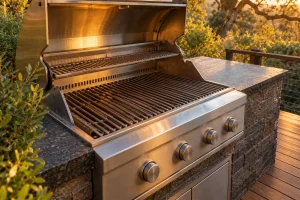
DCS Outdoor Grills
Built-in and freestanding DCS grills in Series 7 and Series 9: how to read the lineup, where the model label sits, and…

Specialized DCS Appliance Repair in San Francisco
Mon–Sat: 8:00 AM – 7:00 PM
Ignition trouble, weak flames or fog-worn hardware on your DCS grill? We diagnose it on site and quote before any work starts.
A DCS grill is built to live outdoors, but a deck in the Sunset, a roof terrace in SoMa or a back garden in Oakland tests it in different ways. Fog settles on the stainless every evening, salt air works at fasteners and igniter terminals, hill wind pushes flames around, and winter rain finds every gap. When a built-in or freestanding DCS grill stops behaving, we diagnose first, put the findings in a written estimate, and repair nothing until the owner approves it.
Most grill calls sort into a few symptom groups, and the group usually points at the system to examine.
The clicking may be loud and steady with no flame, or there may be no click at all. A technician looks at the spark module and its wiring, the igniter electrode and its gap to the burner, moisture or grease on the electrode tip, and whether gas is actually reaching the burner. Salt air and damp mornings are common reasons an electrode that worked all summer goes quiet in October. Our guide to a DCS grill that won’t ignite walks through what to observe before you call.
One side of the cooking surface runs hot while the other lags, or the flame stays small even with the knob turned to high. Likely causes include spider webs or debris in the burner tubes, a regulator that is not delivering steadily, a partly closed tank valve on a propane setup, or burner ports that have clogged with drippings. The write-ups on uneven grill heat and a low flame on high cover the owner-side observations.
Wind on a hillside lot can blow a burner out, but a flame that dies in calm air points to the gas supply, the burner venturi, or a flame that has been starved of air. Yellow, lazy flames deserve attention because they suggest the air and gas mix is off.
A rotisserie motor that stalls, interior lights that flicker, or knobs that feel loose or gritty are more often a connection or wear problem than a total failure. Outdoor wiring takes a beating from moisture, and a corroded connector can imitate a dead component.
We start by listening to what you saw: which burner, how it behaved, what the weather was doing, and when the problem began. Then we inspect the grill in the order the gas and spark follow. Supply first, then regulator and valves, then the burner and its ports, then the ignition system and wiring. Only after that do we look at secondary parts like the rotisserie motor or lights. The findings are written into an estimate in plain language, and you decide what goes ahead.
If something looks unsafe, such as a leak sign at a fitting or damaged hose, we stop and say so before anything else happens. Gas connections are never a place to improvise.
A built-in grill sits inside a masonry or framed island, and the cutout, the insulating jacket if one is fitted, and the ventilation openings in the island all matter. Blocked island vents can trap heat or gas, and we check them as part of any visit. Tight cabinetry also determines how easily the grill can be reached or slid out, which we note in the estimate.
Many DCS grills are supplied for liquid propane, and many Bay Area yards run natural gas to the island. The two use different orifices and regulation, and a grill that was converted or moved between fuels can show symptoms that only make sense once you know its history. Tell us which fuel it runs on, and whether the grill ever changed fuel. The trailing letter in the model name often hints at it: -L means propane and -N means natural gas.
Homes near the ocean and the Bay see faster corrosion on igniter terminals, hinges and fasteners, and roof decks add wind that disturbs burner flames. Moisture trapped under a cover can do its own damage, so we look at how the grill is stored.
The ignition and lights need power at an outdoor GFCI outlet. A tripped GFCI after rain is one of the quietest causes of a grill that suddenly will not spark.
These are from the outside only. None involves tools or opening anything.
Do not remove panels, adjust regulators or touch gas fittings.
If you smell gas, leave the area, do not touch switches or light anything, and call your gas utility or 911 from a safe distance. On propane, close the tank valve first if you can do so safely. Never light a grill with the lid closed, never relight after a gas smell, and never hold a match near a burner that failed to light. If you see sparks, melted wiring or smell something burning, switch the power off at the breaker and leave the grill unused.
The model number tells us the series, width and fuel, and it decides which parts apply. It is usually found under the control panel, or on the firebox or drip-tray area. Our short guide on finding your model number shows where to look. For example, a BE1 grill is a Series 9 built-in, and a BH1 grill is a Series 7 built-in. The size in the name, such as 36 or 48, is the width in inches.
You send a request through the contact page with the model number, the fuel and a short description. We confirm the visit window for your address in San Francisco or the surrounding Bay Area. On arrival we look at the grill and its installation, run through the symptoms with you, and produce the written estimate. If you approve, the repair proceeds, and we test the grill in operation before we leave.
For the lineup and what each series offers, see our DCS outdoor grill guide. If you own one of these, the model pages carry specific notes: BE1-36C-L, BH1-48-L and BG36-BQARN.
Clicking means the spark module is working and trying to fire, so the usual suspects are a dirty or wet electrode, a poor gap between electrode and burner, a closed gas valve or an empty tank. Fog and rain make this common on decks. Check the tank valve and the fuel supply, then book a diagnosis if it persists.
Yes. The orifices, regulation and parts differ between the two, so tell us which fuel it uses and whether it was ever converted. A -L model name indicates propane and -N indicates natural gas.
It can. Moist coastal air reaches terminals and hardware even under a cover, and trapped moisture can sit on the stainless. We look at corrosion on the igniter wiring and fasteners during the diagnosis.
You can wipe visible grease and clear debris you can see without taking anything apart, while the grill is cool. Do not remove panels or touch gas fittings. If the burner tubes themselves need clearing, leave that to the visit.
No. We diagnose first, write up the findings and the estimate, and only repair what you approve.
Built-in and freestanding DCS grills in Series 7 and Series 9: how to read the lineup, where the model label sits, and…
DCS built-in and convection microwave ovens that run without heating, show sensor messages or will not latch, diagnosed safely from the opening…
A burner that will not spark, clicks nonstop or burns with a ragged flame deserves a proper look. We repair DCS gas…
Drain, leak, lid and fill faults on DCS DishDrawer units and the 24-inch dishwasher, diagnosed before repair, with a written estimate for…
Repair for DCS outdoor ice makers in San Francisco and the Bay Area: no ice, slow ice, flashing lights and water line…
Share a few details and we’ll confirm an appointment. Prefer to talk? Call us and we’ll help right away.