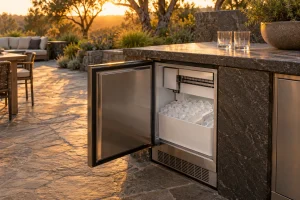
DCS Ice Makers
DCS outdoor ice makers in the RF15I family: how left- and right-hinge versions differ, what flashing indicators mean and which checks are…

Specialized DCS Appliance Repair in San Francisco
Mon–Sat: 8:00 AM – 7:00 PM
Empty bin or flashing lights on your outdoor DCS ice maker? We trace the cause and quote before repairing.
An outdoor ice maker is easy to take for granted until a hot weekend when the bin is empty. DCS ice makers sit in the same island as the grill and refrigerator, drawing on a water line and a drain and working against sun, salt air and wind-blown dust. We repair DCS outdoor ice makers across San Francisco and the Bay Area. We diagnose first, give a written estimate, and repair only what you approve.
A technician starts with the basics of ice making: power, water supply, the inlet valve, the cooling circuit and the sensors that tell the machine when to freeze and when to stop. Our post on an ice machine not making ice covers what to observe. A machine that is switched off, or has gone to its OFF state after a sensor fault, looks the same from the front.
Low water flow, a partly closed supply valve, a clogged inlet screen or mineral deposits can change how ice forms. Hard water in some Bay Area neighborhoods leaves scale behind, and a machine that is never cleaned makes ice that tastes off.
Ice stored in the bin melts slowly by design, and the meltwater drains away. If the drain path is blocked, or the door does not close fully, water collects. High summer temperatures on an unshaded patio add to the load.
A humming pump, a loud fan or dripping underneath can come from the water line, the drain tubing or a fan struggling with dust. See the general guide on an ice maker not working for other signs.
Ice absorbs odors from a dirty bin, a stale water line or food stored nearby. Cleaning the bin and replacing standing water in the supply line usually helps, but a persistent taste can also mean a filter or tubing issue that a technician should see. Mention it when you book so the estimate covers the water side too.
The DCS RF15I outdoor ice maker shows faults with lights, and our code pages describe three. All indicators flashing is a communication error between the main board and the user interface. ICE flashing is a condenser temperature sensor fault, and the machine keeps running but does not adapt to its surroundings. OFF flashing is a bin sensor fault, and the machine goes to its OFF state. Write down which one you see before you reset anything.
We work from the outside in: installation and clearances, power, water inlet and drain, then airflow and the cooling components, and the sensors last. Where a code is showing, we match it to the symptom. The written estimate follows with what we found and what we suggest.
An ice maker needs a clean supply and a clear drain. A kinked supply tube, a closed or partly closed valve or a sagging drain line can stop production or flood the cabinet floor. We look at the whole run, including where the line passes through the island.
The condenser needs air. Units set into a tight cut-out, or those with a kickplate vent full of dust, run warm and make less ice. This gets worse in direct summer sun.
Coastal air corrodes fan motors and fittings. Outdoor GFCI outlets trip after rain and silently switch the machine off. We ask about both.
Do not remove panels, open the cooling circuit or work on the water line behind the unit.
Before the warm months, empty and wipe the bin, clear the vent and make sure the drain runs freely. If the machine will sit unused through a long wet stretch, switch it off at the outlet and leave the bin door ajar so moisture does not linger. These habits keep sensors and fans from clogging.
Water pooling near the outlet, a burning smell or sparks mean switching it off at the breaker and leaving it. Ice that has sat in a warm, dirty bin should be thrown away rather than served.
It tells us the hinge side and the generation, and so which parts match. It is usually found inside the cabinet or on the frame near the door. See how to find the model number. RF15IL3 and RF15IR3 are left and right hinge versions of the outdoor ice maker, RF15I is no longer sold new, and RF15IL2 is another left-hinge model. The 15 is the width in inches.
Use the contact page to send the model, any lights you see and when the problem started. We arrange a time at your address in the city or the wider Bay Area, inspect the machine and its supply and drain, and explain the cause. The written estimate comes before any repair, and we finish by confirming the machine makes ice again.
The DCS ice maker guide describes the lineup. Model notes are on the RF15IL3, RF15IR3 and RF15I pages. If the refrigerator next to it is also warm, see DCS refrigerator repair.
The machine may be making ice and losing it to meltwater, or it may be running without water because of a closed valve or blocked inlet. Check the supply valve and the drain, then book a diagnosis if it continues.
In our code library it is a bin sensor error. The machine goes to the OFF state and gives no audible alarm. Write down the pattern and keep the machine switched on at the outlet until we see it.
If the bin has been warm, dirty or wet, discard the ice. Clean storage and a working drain keep the ice fresh.
Yes. Salt and fog speed up corrosion on fans, fittings and terminals, and dust clogs the vent. We look at both when we inspect.
Yes. The RF15I is no longer sold new, but we still diagnose and repair it. Tell us the model so we can match the parts.
DCS outdoor ice makers in the RF15I family: how left- and right-hinge versions differ, what flashing indicators mean and which checks are…
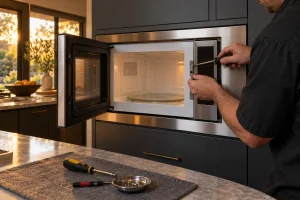
DCS built-in and convection microwave ovens that run without heating, show sensor messages or will not latch, diagnosed safely from the opening…
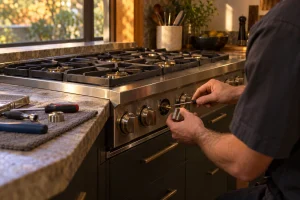
A burner that will not spark, clicks nonstop or burns with a ragged flame deserves a proper look. We repair DCS gas…
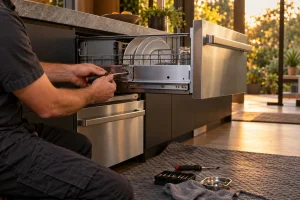
Drain, leak, lid and fill faults on DCS DishDrawer units and the 24-inch dishwasher, diagnosed before repair, with a written estimate for…
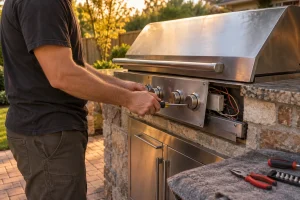
Diagnosis and repair for DCS built-in and freestanding gas grills across San Francisco and the Bay Area, from ignition faults to uneven…
Share a few details and we’ll confirm an appointment. Prefer to talk? Call us and we’ll help right away.