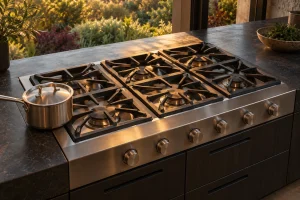
DCS Cooktops and Rangetops
Guide to DCS gas cooktops and rangetops in the Bay Area: the CT, CDU, CDV2 and CP models, common burner complaints, safe…

Specialized DCS Appliance Repair in San Francisco
Mon–Sat: 8:00 AM – 7:00 PM
Gas cooktops and rangetops in islands and cabinet runs, checked burner by burner.
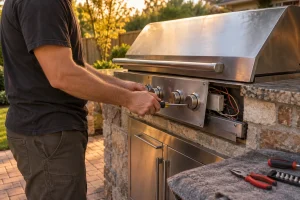
A gas cooktop or rangetop gives you open flame, fast response and a clear view of what you are cooking, which is why cooks choose it. When a burner sulks, sparks forever or burns with a ragged flame, the whole surface feels unreliable. We repair DCS gas cooktops and rangetops across San Francisco and the Bay Area, from drop-in units in island counters to wide rangetops set into a run of cabinets.
Start with the obvious: a burner cap that sits crooked, an igniter coated in boil-over, or a port packed with dried sauce. If a single burner is silent while its neighbors spark, the fault is local to that burner, such as its igniter, its electrode or its lead. If every burner is silent, we look at the spark module, the switch block or the power to the unit.
A burner that keeps sparking after the flame is established, or sparking that begins by itself when nothing is on, is almost always moisture or residue near an electrode, or a switch that has stuck. Left alone, it wears the module quickly.
Flame shape tells a technician a great deal. Yellow tips suggest a poor air mixture or a dirty burner. A flame that lifts off the ports or roars can mean pressure issues, a wrong orifice after a fuel change or a cap that is not fully seated. Our article on uneven flame on a cooktop burner describes what to look for.
If a burner lights, then goes out when turned down, it may lack a good flame sensor or may be fed too little gas at the simmer position. We check the valve, the simmer setting and the burner head for damage.
Knobs that spin loosely, a valve stem that feels gritty or a stove-top finish that has pitted from salt air are common reasons we are asked to visit. Some of these are cosmetic, and some begin to affect safe operation, so we sort out which is which.
Where a cooktop is mounted shapes both how it fails and how it is serviced. In an island, the unit sits over cabinets with limited access underneath, and the gas connector and power cord are often routed tightly. We check that the cut-out is the right size, that nothing in the cabinet below touches the burner box and that the flexible connector is not kinked. A unit with a drawer or a shelf too close to the underside can overheat its own components.
Ventilation counts as well. A professional-capacity hood or a downdraft pulling hard can draw the flame sideways or snuff a low burner, especially in a tight apartment with little make-up air. If you have just changed the hood or sealed up an older house, mention it. Our hood repair service covers that side of the system when the hood turns out to be the cause.
A cooktop is set up for one fuel, and the CDV2-365-N, a 36-inch natural gas model, is an example of a unit labeled by fuel. Switching to propane takes the right conversion parts and orifices. Burners that pop, flutter or refuse to simmer after a conversion usually have a setup problem, not a failed part. If your gas supply changed with a remodel, we check the regulator and the orifice sizes before replacing anything.
Never remove the control panel or work on gas fittings yourself.
If you smell gas, leave the home, do not use switches or phones inside, and call the gas utility or 911 from outside. Stop using the cooktop if a burner will not shut off, if flame comes from beneath the burner, if you hear a hiss with no flame or if a knob feels hot while the burner is off. Switch off the breaker if you smell burning wiring.
The label on a cooktop is usually under the surface edge, on the burner box or on the underside, so a photo from the cabinet below is often the easiest approach. Look at our DCS cooktop guide to see how the series are arranged. Units we see include the CT-365BL, a 36-inch Professional drop-in cooktop; the CDU-304 and CDU-365 in the CDU/CDV series, no longer sold new; the CDV2-365-N; and the CP-364GD. The BGC-1236 is another gas cooktop that reaches us. A model number lets us arrive with the correct igniter, electrode and orifice set.
If your cooking surface is part of a full range, you may want the range repair page instead.
Request a visit, describe the burner problem and share the model if you can. We agree on a time, diagnose before touching a part, and provide a written estimate. You tell us whether to go ahead.
Debris in the ports or a dirty electrode slows ignition on that burner. Cleaning the head carefully helps, and if it persists, the igniter may be weak.
We advise against it. Stay clear of the burner, leave the area if you smell gas and call us once the cooktop is off and cool.
Homes near the water can see corrosion on knobs, caps and electrodes over time, especially with windows open much of the year.
A properly converted cooktop should burn steadily. Popping or roaring afterward suggests the setup needs adjusting.
Yes. We tell you plainly what the unit needs and let you decide what to do next.
Guide to DCS gas cooktops and rangetops in the Bay Area: the CT, CDU, CDV2 and CP models, common burner complaints, safe…
DCS built-in and convection microwave ovens that run without heating, show sensor messages or will not latch, diagnosed safely from the opening…
Drain, leak, lid and fill faults on DCS DishDrawer units and the 24-inch dishwasher, diagnosed before repair, with a written estimate for…
Repair for DCS outdoor ice makers in San Francisco and the Bay Area: no ice, slow ice, flashing lights and water line…
Diagnosis and repair for DCS built-in and freestanding gas grills across San Francisco and the Bay Area, from ignition faults to uneven…
Share a few details and we’ll confirm an appointment. Prefer to talk? Call us and we’ll help right away.