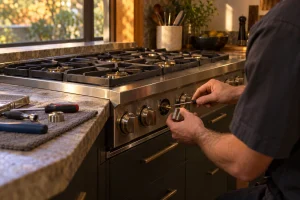
DCS Cooktop and Rangetop Repair
A burner that will not spark, clicks nonstop or burns with a ragged flame deserves a proper look. We repair DCS gas…

Specialized DCS Appliance Repair in San Francisco
Mon–Sat: 8:00 AM – 7:00 PM
From lineup and model labels to ignition trouble and uneven flames, a plain guide to the gas cooktops we repair across the Bay Area.
A gas cooktop or rangetop is the part of a kitchen where small faults get noticed first: a burner that lights late, a flame that leans to one side, a knob that clicks long after the flame is up. This guide covers the DCS cooktops and rangetops we see around San Francisco and the Bay Area, what each complaint usually points to, and what you can safely look at before you ask for a visit. Service details live on our DCS cooktop repair page.
DCS gas cooktops come as drop-in units cut into a countertop and as rangetops that sit on a cabinet base. The models we have on file give a feel for the spread. The CT-365BL is a 36-inch gas cooktop in the Professional drop-in (CT) series. The CDU-304 is a 30-inch gas cooktop and the CDU-365 is its 36-inch sibling, both from the CDU/CDV group, and both are no longer sold new. The CDV2-365-N is a 36-inch CDV2 gas cooktop built for natural gas, also no longer sold new. The CP-364GD belongs to the CP series and is no longer sold new either. The BGC-1236 is a gas cooktop.
On a drop-in cooktop the data plate is normally on the underside of the cooktop body or on the cabinet frame beneath it, which means you often cannot read it with the unit installed. Check the paperwork from the installer first, then look for a sticker on the inside of the cabinet door or drawer directly below. Never lift the cooktop to look for it. A photo of any label you can reach lets us narrow the model down.
Gas cooktops have no error codes to read, because these units usually signal trouble through ignition behavior rather than a display. If your appliance is a rangetop paired with an oven that shows a fault, check the oven section of this guide through DCS wall oven F-number codes.
Stay on the outside of the unit. Make sure every burner cap sits flat and in the right position, wipe visible debris from around the burner base once the cooktop is cold, and dry the area if the sink or a pot boiled over. Confirm the household breaker has not tripped. If the cooktop is on natural gas, look at whether the shutoff valve near the appliance is in line with the pipe. If a gas smell appears, leave the kitchen, touch no switches, and call the gas utility or 911 from outside.
Do not use a match or lighter to force a burner that will not spark, and do not pull out burner heads, bend igniters or loosen any gas fitting. Burning smells, scorched knobs or visible sparking outside the burner call for turning the cooktop off and switching off its breaker.
The CDV2-365-N is natural gas, and that detail matters because a burner tuned for one fuel behaves badly on another. Cut-out clearance, the vent hood above and the cabinet below also change how heat and fumes gather around the unit, so we look at the installation as well as the cooktop.
We start with the model number and a description of what the burners do, then diagnose before we repair anything. You get a written estimate, and nothing is repaired without your approval. Book through our contact page or read the full process on DCS cooktop repair. The DCS CT-365BL repair and DCS CDV2-365-N repair pages cover those two models in detail.
The CDU-304, CDU-365, CDV2-365-N and CP-364GD are listed as discontinued. That does not stop us from diagnosing and repairing them, because service depends on the model number rather than on whether it is still sold.
No. A burner that fails to ignite is a reason to turn the knob off, ventilate the room and leave it alone. If you smell gas, go outside and call the gas utility or 911.
Usually the digits after the prefix show the width in inches, so a CT-365BL is a 36-inch cooktop. We still ask for the full model because the width alone does not tell us which burners or controls it has.
Spills or moisture around the igniter can cause repeated sparking. Switch the burner off, let the surface dry, and if clicking returns, book a diagnosis instead of using the burner.
The model number from any label you can reach, the burner or burners affected, whether the gas is natural or propane, and a short note of when the problem started.
A burner that will not spark, clicks nonstop or burns with a ragged flame deserves a proper look. We repair DCS gas…
Guide to DCS built-in and convection microwaves in the Bay Area: the CMO24SS and CMOH-30SS, no-heat and sensor complaints, safe checks and…
Guide to DCS DishDrawer dishwashers in the Bay Area: single and double drawer models, F and U codes, leaks, draining trouble and…
DCS outdoor ice makers in the RF15I family: how left- and right-hinge versions differ, what flashing indicators mean and which checks are…
Built-in and freestanding DCS grills in Series 7 and Series 9: how to read the lineup, where the model label sits, and…
Share a few details and we’ll confirm an appointment. Prefer to talk? Call us and we’ll help right away.