
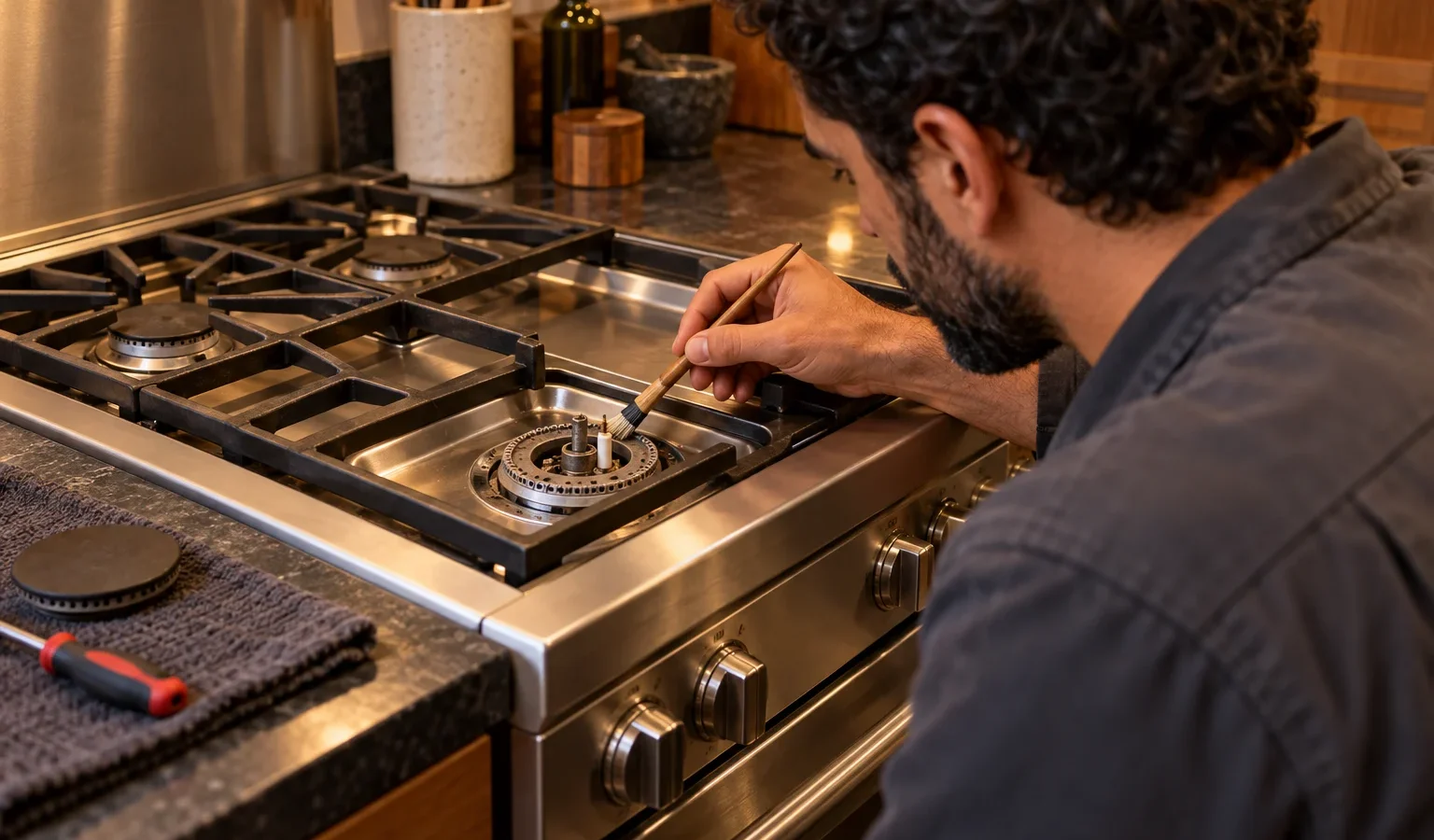

Specialized DCS Appliance Repair in San Francisco
Mon–Sat: 8:00 AM – 7:00 PM
A gas range burner that clicks but never lights, or does not click at all, usually has a simple cause. Know which checks are safe and when to stop and call.
If you smell gas at any point, do not switch anything on or off, do not try to light another burner, and do not use a phone near the range. Leave the home and call the gas utility or 911 from outside. Do not return until you are told it is safe. If there is no smell, you can work through the checks below. Never use a match near a burner that failed to light, because gas may have built up at the surface.
When you turn a knob on a professional range, the valve opens, gas flows to the burner, and a spark igniter fires to light it. On most models the sparking starts the moment you turn the knob. If the burner does not light, the spark may be missing, weak or in the wrong place, or the gas may not be reaching the burner, or something may be blocking it. Listening is a useful tool: a steady, fast click means the igniter is trying; silence means it is not.
Power is the first suspect. Check that the range is plugged in and the breaker is on, since gas ranges still need electricity for ignition. A power cut or a tripped breaker will silence all the burners together. If only one burner is silent, its igniter, switch or wiring is involved.
This is the most common version. Spark is present, but the burner will not catch. Possible reasons include food debris or boil-over in the burner ports, a wet igniter or burner cap, a cap that has been put back crooked, and a supply problem. After rain or a stormy damp week, moisture in a kitchen with open windows can cause temporary trouble. Dry the cap and ports gently and try again.
A flame that lifts or dies suggests that gas flow or airflow is wrong. Spills, a misaligned cap, or a gust of air from a nearby window or from a hood on high speed can blow it out. Try a lower hood speed and close the window.
If every burner fails, think about the gas supply valve to the range or a power supply issue. If only one burner fails, look at that burner and its parts. The same symptom with different scope tells us a lot.
Do not open panels, adjust valves, or disconnect the gas line. Do not light burners with a match or lighter if the electric ignition fails, particularly when you are unsure of the cause. Avoid soaking the burner parts in water and putting them back damp. Do not bypass switches. If you notice sparks outside the burner area, a burning smell or smoke, power off at the breaker.
Gas and dual-fuel ranges both depend on a gas supply, a regulator that suits the fuel and a properly installed shutoff valve. A range that was moved or reconnected might have a loose or incorrectly set supply, which only a qualified installer should address. A hood above that pulls hard can disturb flames, and a gap between the range and the countertop influences airflow. Models include the DCS RGS-305 gas range, which is no longer sold new, and the dual-fuel DCS RDS-305, also no longer sold new.
Burner layouts, igniter styles and control modules differ between range series, so the label on the oven frame or behind the drawer tells a technician which parts apply. A photo of it, taken with the oven door open, is enough. Tell us as well whether the range runs on natural gas or propane, since that changes what we check at the supply.
Wipe up boil-overs once the burner has cooled, because dried sugar and grease are the usual cause of blocked ports. Lift the caps now and then and check that they sit flat. These small habits keep ignition reliable between visits.
If the checks do not bring a flame, or if only one burner has stopped working, book our DCS range repair service. The technician checks the igniter, the spark module, the burner parts, the supply and the controls, and gives you a written estimate. Nothing is repaired without your approval. Our DCS ranges page describes the lineup. If your range keeps clicking even when a flame is present, read the post about a DCS range clicking continuously.
Spark alone is not enough. The burner needs gas and a clean path to the igniter. Debris, moisture or a misplaced cap are frequent reasons. A weak igniter is another.
We advise against it. If a burner failed to light, gas may have gathered, and a match could ignite it unexpectedly. Call for a diagnosis instead.
Check the power and the gas shutoff valve first. If both are fine, the issue could be the ignition module or the supply, which needs a technician.
The oven has its own ignition system, so it may work. If the range smells of gas or acts strangely, do not use any part of it.
Moisture on caps and igniters can stop ignition for a while. Dry the parts and try again once the range has cooled.
Share a few details and we’ll confirm an appointment. Prefer to talk? Call us and we’ll help right away.