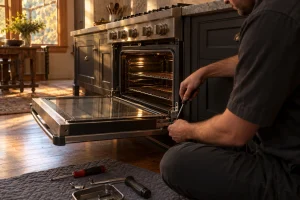
DCS Range Repair in San Francisco
Burners that will not light, ovens that run cool or clicking that never stops. We diagnose and repair DCS gas and dual-fuel…

Specialized DCS Appliance Repair in San Francisco
Mon–Sat: 8:00 AM – 7:00 PM
A professional range is built to run hard. This guide decodes the model names and explains the faults that bring owners to us.
Homes across San Francisco and the Bay Area, from flats to hillside houses, often have a DCS range as the anchor of the kitchen. A heavy cooktop over a large oven asks a lot of its gas supply, igniters and electronic controls. For repairs, start at DCS range repair.
Model prefixes tell you the fuel setup. The R-G models are gas ranges, with a gas cooktop and a gas oven. The R-D models are dual fuel, pairing a gas cooktop with an electric oven. The models include the RGS-305, RGT-305 and RGU486GDN gas ranges, the RGSC-305BK, a 30-inch gas range, and the RGCV2-305 from the Professional V2 series. Dual-fuel entries are the RDS-305, RDT-305 and RDV2-304. The RGS-305, RDS-305, RDV2-304, RGCV2-305, RGT-305 and RGU486GDN are no longer sold new, and parts questions are answered case by case.
Open the oven door and look along the oven frame, then check the edge of the storage drawer opening. The plate is usually on the frame. Photograph it clearly, including the serial number.
A burner that clicks but stays dark, a flame that is lopsided or one that pops back to a lazy yellow all point to a few causes: spilled food in the burner head, a damp or dirty igniter, or an uneven gas flow. Two articles cover this in depth: range burner not igniting and range clicking continuously. Continuous clicking after the flame is lit is often a sign that the spark module senses something wrong.
If you smell gas, leave the kitchen, avoid switches and call the gas utility or 911 from outside. Never pull the range forward to hunt for a leak, and never test fittings with a flame.
Send a photo of the plate and note the symptom. We diagnose before repair, provide a written estimate and proceed only on your say-so. Cooktops that sit apart from an oven are covered in the cooktop guide.
A range is only as reliable as the supply behind it. A gas valve partly closed, a flexible connector kinked by pushing the range back, or a regulator set for the wrong fuel all produce symptoms that look like failed parts. Tip-over brackets and the wall behind the range also matter for safe service. Dual-fuel models add a dedicated electrical circuit, so a tripped breaker can disable the oven while the cooktop still lights. Ventilation matters as well, since a hood that is too weak for the range leaves heat and grease in the kitchen.
Igniters, valves, controls and oven parts differ between series. Reading the full number from the plate tells us whether you have the standard series or the Professional V2 line.
Stop cooking if a burner flame climbs high, shoots out of the cap or smells of gas, and leave the oven closed if smoke appears with nothing inside. Switch off the knobs and, for anything electrical, the breaker.
RGS marks a gas range with a gas oven, while RDS marks a dual-fuel range, which pairs a gas cooktop with an electric oven.
Clicking means the igniter is still sparking. If you smell gas, leave and call the utility. Otherwise turn the knobs off and check for spilled food or a loose cap.
Yes, many are in daily use. Parts availability is discussed in the estimate after diagnosis.
A single burner usually points to its own igniter, cap or port, rather than the supply. A whole-range fault suggests gas supply or a control.
Usually on the oven frame or near the storage drawer opening. A clear photo is enough for us.
Burners that will not light, ovens that run cool or clicking that never stops. We diagnose and repair DCS gas and dual-fuel…
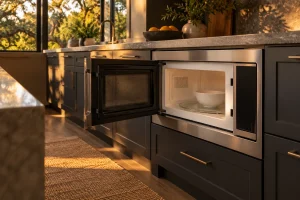
Guide to DCS built-in and convection microwaves in the Bay Area: the CMO24SS and CMOH-30SS, no-heat and sensor complaints, safe checks and…
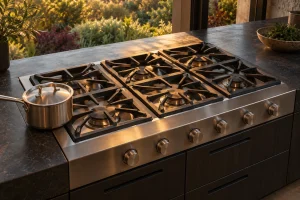
Guide to DCS gas cooktops and rangetops in the Bay Area: the CT, CDU, CDV2 and CP models, common burner complaints, safe…
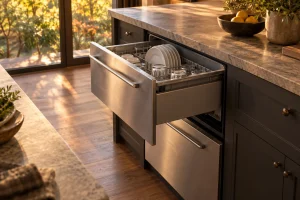
Guide to DCS DishDrawer dishwashers in the Bay Area: single and double drawer models, F and U codes, leaks, draining trouble and…
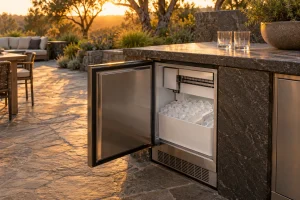
DCS outdoor ice makers in the RF15I family: how left- and right-hinge versions differ, what flashing indicators mean and which checks are…
Share a few details and we’ll confirm an appointment. Prefer to talk? Call us and we’ll help right away.