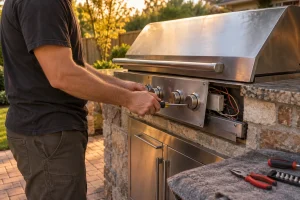
DCS Outdoor Grill Repair in San Francisco
Diagnosis and repair for DCS built-in and freestanding gas grills across San Francisco and the Bay Area, from ignition faults to uneven…

Specialized DCS Appliance Repair in San Francisco
Mon–Sat: 8:00 AM – 7:00 PM
Island grills on a deck, a roof terrace or a back garden take a lot of weather. Here is how the DCS lineup is organized and what usually goes wrong.
A DCS grill sits at the center of most outdoor kitchens we visit around San Francisco, Oakland and the Peninsula. Some are built into masonry or steel islands, others roll on a cart, and the lineup spans two generations of design. This guide sorts out which grill you own, where to find its label, what tends to fail and what you can safely check yourself. For the repair process itself, see DCS outdoor grill repair.
Series 9 built-in grills carry model numbers that begin with BE1, and Series 7 built-ins begin with BH1. The number after the prefix is the cooking width in inches, and a trailing -L means the grill is set up for propane, while -N means natural gas. Within Series 9 the models include the BE1-30AG-L, a 30-inch all grill, plus the BE1-36C-L and BE1-48C-L at 36 and 48 inches. Series 7 includes the BGC30-BQ-L at 30 inches, the BH1-36-L and the BH1-48-L. All of these are propane versions and are still sold new.
Older BG and BGA grills also come through our schedule, such as the BG27-BQRN, the BG36-BQARN, the BG48-BQRN and the BGA26-BQ. Their fuel letters are part of the model name, which is one more reason to read the label before ordering any part.
The data plate is usually under the control panel, on the firebox, or near the drip tray area, and sometimes you need to pull the tray or open the access door to read it. Photograph the plate and the serial number in good light. If the island was built around the grill, the label may be hard to reach, so a photo of the full front and the control knobs also helps us narrow things down. A short walk-through is in how to find your DCS model number.
Salt air near the ocean and the Bay speeds up corrosion on igniter electrodes, burner ports and wiring, and spiders and grease buildup can block the small openings that carry gas to the flame. Our troubleshooting articles on a grill that will not ignite, uneven heat and a low flame on high walk through each symptom.
If you smell gas, leave the area, avoid switches, and call the gas utility or 911 from a safe distance. Burning smells or sparks mean power off at the breaker. Do not open panels or touch gas fittings.
When the checks do not solve it, book a visit through the grill repair service page. A technician diagnoses first, you receive a written estimate, and nothing is repaired until you approve it.
It is usually on a plate under the control panel or on the firebox near the drip tray. Photograph it before you call so we can match parts to the right grill.
A trailing -L marks a propane (LPG) grill and -N marks natural gas. Fuel type matters because the orifices and regulator differ between the two.
The cause may be a weak battery, a wet or corroded igniter, a closed gas valve, an empty propane tank or blocked burner ports. The checks above separate the easy causes from a failed part.
Ventilation and clearances to combustible surfaces are decided by your installation and local rules, not by the grill alone. If you are unsure, ask us to look at the setup during a visit.
Yes. Built-in and freestanding models from both series are covered, along with the older BG and BGA grills listed above.
Diagnosis and repair for DCS built-in and freestanding gas grills across San Francisco and the Bay Area, from ignition faults to uneven…
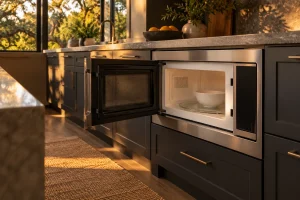
Guide to DCS built-in and convection microwaves in the Bay Area: the CMO24SS and CMOH-30SS, no-heat and sensor complaints, safe checks and…
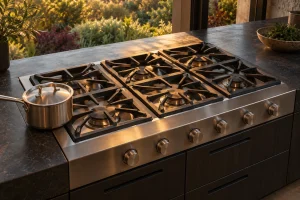
Guide to DCS gas cooktops and rangetops in the Bay Area: the CT, CDU, CDV2 and CP models, common burner complaints, safe…
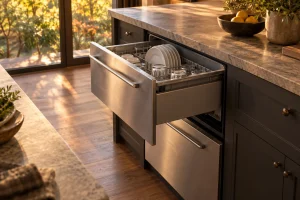
Guide to DCS DishDrawer dishwashers in the Bay Area: single and double drawer models, F and U codes, leaks, draining trouble and…
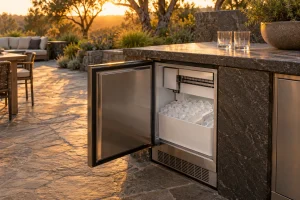
DCS outdoor ice makers in the RF15I family: how left- and right-hinge versions differ, what flashing indicators mean and which checks are…
Share a few details and we’ll confirm an appointment. Prefer to talk? Call us and we’ll help right away.