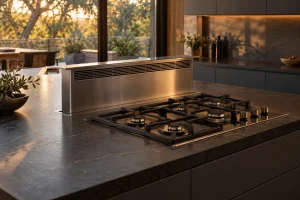
DCS Ventilation Hoods and Downdrafts
Guide to DCS wall and island hoods and downdraft vents in the Bay Area: lineup, weak suction, downdrafts that stay down, safe…

Specialized DCS Appliance Repair in San Francisco
Mon–Sat: 8:00 AM – 7:00 PM
Smoke lingering, a downdraft stuck down or a fan gone noisy? We check the vent, the duct path and the controls, then give you a written estimate.
A ventilation hood or downdraft vent does one job that people only notice when it fails: it moves cooking air out of the room. When it does that poorly, the kitchen fills with smoke, grease settles on cabinets, and the smoke alarm becomes the cooking timer. We repair DCS wall and island hoods and DCS downdraft vents for homes in San Francisco and across the Bay Area, and we begin with how the system is installed and how it fails, not with a guess at a part.
When a hood stops capturing smoke, the blower may be running below its normal strength, but the more common causes sit around it: grease filters packed with residue, a damper stuck partly closed, a duct with a crushed section, or an exterior cap clogged with lint and grease. Our article on a hood that is not pulling smoke walks through these in the order a technician would check them.
A downdraft vent sits behind or beside the cooking surface and rises on cue. When it stays down, the lift may be jammed by debris along the slot, a spilled liquid, a stalled motor or a control that is not sending the command. The piece on a downdraft that is not rising goes into the symptoms in detail.
A fan that rattles or hums usually has a loose mounting, an unbalanced blower wheel, a filter that is not seated, or a duct joint that has worked loose. Noise that appears suddenly after cleaning often traces back to a filter that was put back crooked.
Dead lights, buttons that do nothing or a fan that runs on only one setting point to the controls, the wiring path or a bulb socket. These are small problems that still deserve a proper look, because the same wiring feeds the motor.
A hood is only as good as the path behind it. In older Bay Area homes the duct often runs a long way through a wall or a roof to reach a cap, and every bend, flex section or flattened corner steals airflow. A short run to an outside wall is a different animal from a long run up through the roof. Roof caps in windy, foggy neighborhoods collect moisture and grease, and a damper that sticks open lets cold air drift back down while one that sticks shut blocks the airflow entirely.
Makeup air is the other half. A tight, well-sealed modern kitchen cannot exhaust air that has nowhere to come from, so a strong hood may seem weak when the house is closed up, and a window opened a crack suddenly makes it work. We ask about this because it separates a house problem from an appliance fault.
Downdraft units have their own conditions. They live inside the cabinet next to or behind the cooktop, with ducting that routes down and out through the cabinet base. We look at whether the cabinet cut-out leaves room for the lift to travel, whether the duct below is crushed by stored items and whether the slot has collected cooking debris.
Do not open the housing, reach into the blower, or remove the lift cover on a downdraft. The blower wheel can start without warning, and the lift mechanism can pinch.
Turn the fan off at the breaker if you smell burning, see sparks, hear grinding or scraping from the motor, or notice smoke coming from the hood housing itself. Grease in a duct that has not been cleaned is a fire risk, so do not cook on high heat under a hood that is clearly choking. If you smell gas at any time, leave the home, switch nothing on or off, and call the gas utility or 911 from outside.
Hoods and vents are not interchangeable between lines. A blower, lift motor or control that suits one model can be wrong for the next, and the kitchen’s ducting changes what a technician needs to bring. On a hood the label is usually inside near the filters, and on a downdraft it is often visible once the cover or filter is lifted out. Take a clear photo of it.
The units are the HD30, a 30-inch downdraft vent hood, the DCS-VH-30HS from the VH series, no longer sold new, and the 30-inch DD-30SS and 36-inch DD-36SS downdraft vents from the Dynamic Cooking Systems line, which are also no longer sold new. We still diagnose older units, and we tell you at the estimate if a part is hard to find.
When you contact us, send the model number, a short description and, if you can, a photo of the label and of the duct cap outside. We confirm an appointment window. The technician starts with the installation and the airflow path, then tests the blower, controls and, on a downdraft, the lift. You get a written estimate before any work begins, and nothing is repaired without your approval.
For the full line of products, see the guide to DCS ventilation hoods. A hood that is suddenly weak next to a new range may also be related to the cooking surface, so you might want to read about DCS range repair or cooktop repair if both seem off.
Clean the grease filters and seat them properly, check that the exterior cap opens freely, and try opening a window slightly. If the pull improves, the issue is airflow in the house or the duct; if not, the blower or damper needs a look.
Debris in the slot, a spill, a stalled lift motor or a control fault can all stop it. Clear what you can see from the opening, avoid forcing it, and book a diagnosis.
Often yes. We diagnose first and tell you in the written estimate whether parts are available, so you can decide before any work starts.
A rattle is usually a loose filter or mounting. Grinding, scraping or a burning smell is different: switch the fan off at the breaker and call us.
No. Duct work is not an owner task. Clean the filters, report what you see at the cap, and we will examine the rest during the visit.
Guide to DCS wall and island hoods and downdraft vents in the Bay Area: lineup, weak suction, downdrafts that stay down, safe…
DCS built-in and convection microwave ovens that run without heating, show sensor messages or will not latch, diagnosed safely from the opening…
A burner that will not spark, clicks nonstop or burns with a ragged flame deserves a proper look. We repair DCS gas…
Drain, leak, lid and fill faults on DCS DishDrawer units and the 24-inch dishwasher, diagnosed before repair, with a written estimate for…
Repair for DCS outdoor ice makers in San Francisco and the Bay Area: no ice, slow ice, flashing lights and water line…
Share a few details and we’ll confirm an appointment. Prefer to talk? Call us and we’ll help right away.