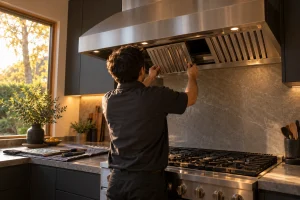
DCS Ventilation Hood and Downdraft Repair
Weak pull, downdraft that will not rise, noisy fans and dead controls on DCS hoods and vents, diagnosed with the duct and…

Specialized DCS Appliance Repair in San Francisco
Mon–Sat: 8:00 AM – 7:00 PM
When smoke hangs around or a downdraft stays flat, the cause may sit in the duct as much as in the fan.
A ventilation hood or downdraft vent does quiet work until it stops: grease film collects on cabinets, the kitchen smells of last night’s dinner, or a downdraft that used to rise stays flat. For DCS hoods in San Francisco and Bay Area homes, this overview explains the types, what typically fails, and how to check basics from the outside. The full service description is under DCS hood repair.
Our scope takes in wall and island hoods and downdraft vents. The HD30 is a 30-inch downdraft vent hood. The DCS-VH-30HS is a hood in the VH series that is no longer sold new, and the DD-30SS and DD-36SS are downdraft vents, 30 and 36 inches, from the Dynamic Cooking Systems series, also no longer sold new. A downdraft sits behind or beside the cooking surface and pulls fumes down, where a canopy hood captures them overhead.
On a canopy hood the label is usually inside, near the filters, so slide a filter out and look along the interior wall. On a downdraft vent it tends to be on the housing that shows when the vent is raised or on the cabinet interior beneath the cooktop. Take a photo and keep it with your records. If you cannot read it, our guide to finding a model number suggests other spots.
We do not list verified error codes for hoods and downdrafts. Diagnosis rests on what you observe: whether the fan starts, whether the vent moves, and what you hear.
Clean the metal filters according to the care instructions, let them dry fully and put them back. Wipe visible grease from the underside and the grille with a damp cloth, with the hood off. Clear anything blocking a downdraft slot or intake, such as a cutting board or a cloth. Check the breaker and, if the hood is plugged in, that the plug is seated. One controlled power reset is fine.
Do not climb onto the cooktop to reach a hood, unscrew a cover, or try to straighten a duct. A burning smell, a hot motor odor or sparking is a reason to switch off at the breaker. If a gas cooktop is installed underneath and you smell gas, leave the home, avoid switches, and call the gas utility or 911 from outside.
A hood is only as good as the path behind it. Long duct runs, extra elbows, a roof or wall cap clogged with leaves, or a tight, sealed house that does not allow replacement air will all weaken capture even when the blower is healthy. In coastal neighborhoods, fog and salt air can also corrode an exterior cap or damper. We look at the full path during diagnosis, not just the fan.
Tell us the type of hood, the model label if you have it, and how the problem behaves. We diagnose first, provide a written estimate, and repair only with your approval. Reach us through the contact page. Details for two models are on DCS HD30 repair and DCS DD-36SS repair.
The DCS-VH-30HS, DD-30SS and DD-36SS are listed as discontinued.
Common reasons are greasy filters, a blocked duct or cap, or too little replacement air in the room. A technician traces the airflow path instead of replacing the motor on a guess.
With the hood off and cool, slide the filters out, wash them as the care instructions describe, let them dry completely, and refit them. Leave the blower and ductwork alone.
Not necessarily. Rising is a mechanical and control matter, separate from the blower. Make sure nothing blocks the slot, check the breaker, and request a diagnosis.
They can affect exterior caps, dampers and metal surfaces over time, particularly close to the ocean or the Bay. It is one of the conditions we check for during a visit.
Weak pull, downdraft that will not rise, noisy fans and dead controls on DCS hoods and vents, diagnosed with the duct and…
Guide to DCS built-in and convection microwaves in the Bay Area: the CMO24SS and CMOH-30SS, no-heat and sensor complaints, safe checks and…
Guide to DCS gas cooktops and rangetops in the Bay Area: the CT, CDU, CDV2 and CP models, common burner complaints, safe…
Guide to DCS DishDrawer dishwashers in the Bay Area: single and double drawer models, F and U codes, leaks, draining trouble and…
DCS outdoor ice makers in the RF15I family: how left- and right-hinge versions differ, what flashing indicators mean and which checks are…
Share a few details and we’ll confirm an appointment. Prefer to talk? Call us and we’ll help right away.