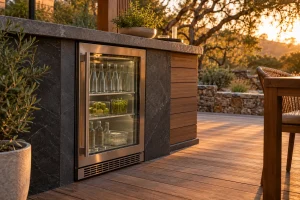
DCS Refrigerators and Beverage Coolers
Outdoor DCS refrigerators, refrigerator drawers, beer dispensers and beverage chillers, plus legacy indoor units: lineup, labels, codes and first checks.

Specialized DCS Appliance Repair in San Francisco
Mon–Sat: 8:00 AM – 7:00 PM
Warm drinks, frosting, alarms or noise? We trace the cause in your DCS refrigerator and quote before any repair.
Outdoor refrigeration works harder than anything in your indoor kitchen. A DCS refrigerator, drawer unit, beer dispenser or beverage chiller sits in a hot afternoon on a south-facing patio, then a damp, foggy night, with a door that is opened constantly during a party. When it warms up, freezes the drinks or starts alarming, we diagnose the cause and repair what you approve. We cover San Francisco and the surrounding Bay Area, including older indoor DCS refrigerators.
This is the most common call. A technician considers the airflow around the cabinet, the condenser fan and coil, the evaporator fan, the defrost system, the door seal and the temperature sensors. Under-counter and island installs tend to suffer from blocked or dusty ventilation. See the longer walk-through on a outdoor fridge that is too warm and, for drawer units, a refrigerated drawer not cooling. A beverage center has its own page: beverage center too warm.
Frozen bottles and ice crystals on food usually suggest a sensor reading incorrectly or a control that is not cycling the compressor off. The controller can raise a low-temperature alarm.
Gaskets stiffen and collect grit, and doors can sag on the hinges if they are loaded heavily. Humid air gets in, frost builds, and the compressor runs longer. See door not sealing for what to look at.
Rattles, humming and fan whine come from loose panels, a fan blade touching ice or debris, or a compressor under strain. A change in sound is often the earliest sign. Read more under refrigerator making noise.
Beer dispensers add taps, lines and a keg or tank arrangement, and pour issues may come from the system outside the cabinet as well as the cooling. Leaks around drawers or the cabinet floor can come from a clogged drain path or a loose fitting.
A musty smell usually points to a blocked drain path or standing moisture in the cabinet floor. Heavy frost on the back wall or around the drawer opening suggests the defrost system is not clearing ice, or that warm humid air is getting in through a poor seal. Both are worth reporting at booking, because they tell the technician where to begin.
Many DCS refrigerators report faults by a beeping pattern or a display message, and the meaning depends on the model. Write down what you see before pressing anything. Some of the codes: the do code means the door has stayed open too long, the Hi code is a high temperature alarm, the Lo code is a low temperature alarm, E1 is a temperature sensor fault, and E2 is a condenser fan motor fault. Numbered codes appear as beep counts or LED patterns; browse the error code index to match yours.
Cooling faults are traced from the outside in. First, installation and surroundings: ventilation, spacing, level, door fit. Then the airflow and fans, the sensors, the defrost components and the sealed side only by observing its symptoms. We do not open or handle sealed refrigeration lines at the owner level, and we tell you plainly what the evidence points to. The written estimate follows, and nothing is repaired until you agree.
Outdoor refrigeration needs air to move around it. A unit pushed into a tight cutout, or hemmed in by stored boxes, runs hotter and wears faster. Kickplate grilles that fill with leaves and dust are a classic reason for slow cooling.
Salt air attacks fan motors, coils and hinges. Afternoon sun on an unshaded unit makes the condenser work much harder. Rain blown into the front grille can wet the electronics.
An outdoor GFCI that trips will switch the refrigerator off without a sound, and the first sign is warm drinks the next day. Drain and water lines also matter, especially on models with ice or tap features.
Do not open panels, test circuits or touch the sealed cooling system.
Before summer, wipe the gasket, clear the kickplate vent and shade the cabinet if you can. After winter storms, check that rain has not pooled near the unit and that the outlet still has power. These small habits catch a failing fan or a dirty coil before a party does.
If you notice a burning smell, sparks or a hot plug, switch it off at the breaker and leave it. Do not trust food or drinks kept for a long time in a unit that has been warm. Any water pooling around electrics needs the power off first.
The model number separates a hinged door unit from a drawer unit, a single-tap from a dual-tap beer dispenser, and left hinge from right. It is usually inside the cabinet on a side wall, or behind the kickplate. Look at how to find your model number. Names such as RF24LE4 and RF24RE4 are left and right hinge refrigerators, RF24DE4 is a refrigerator drawer unit, and BC25 is a beverage chiller and sink.
Request a visit on the contact page with your model and what you observed. We confirm a time at your Bay Area address, inspect the unit and its surroundings, explain the cause, and produce the written estimate. After approval we complete the repair and confirm it is cooling properly.
See the DCS refrigerator guide for the full lineup, or the pages for RF24LE4, RF24DE4 and RF24BTL2.
Lights do not prove the cooling system is running. Check the GFCI and the grille for blockage, then look at whether the fan is turning. If it still is not cold, a diagnosis will tell which part is at fault.
In our code library, Hi is a high temperature alarm. The compartment has run warmer than its setpoint for a while. Check the door, airflow and power, then book if it returns.
Do one controlled power reset after writing down the code. Repeated resetting hides the evidence a technician needs.
Yes. DCS beer dispensers, refrigerator drawers, outdoor refrigerators, beverage chillers and legacy indoor refrigerators are covered.
Sun on the cabinet, a blocked grille and a dusty condenser all force it to work harder. Shading and clearing airflow help, and a diagnosis shows whether a fault is also present.
Outdoor DCS refrigerators, refrigerator drawers, beer dispensers and beverage chillers, plus legacy indoor units: lineup, labels, codes and first checks.
DCS built-in and convection microwave ovens that run without heating, show sensor messages or will not latch, diagnosed safely from the opening…
A burner that will not spark, clicks nonstop or burns with a ragged flame deserves a proper look. We repair DCS gas…
Drain, leak, lid and fill faults on DCS DishDrawer units and the 24-inch dishwasher, diagnosed before repair, with a written estimate for…
Repair for DCS outdoor ice makers in San Francisco and the Bay Area: no ice, slow ice, flashing lights and water line…
Share a few details and we’ll confirm an appointment. Prefer to talk? Call us and we’ll help right away.