

Specialized DCS Appliance Repair in San Francisco
Mon–Sat: 8:00 AM – 7:00 PM
When an outdoor refrigerator drawer warms up, the cause is often airflow, a loose seal or a fan that stopped. Work through the checks and know when to call.
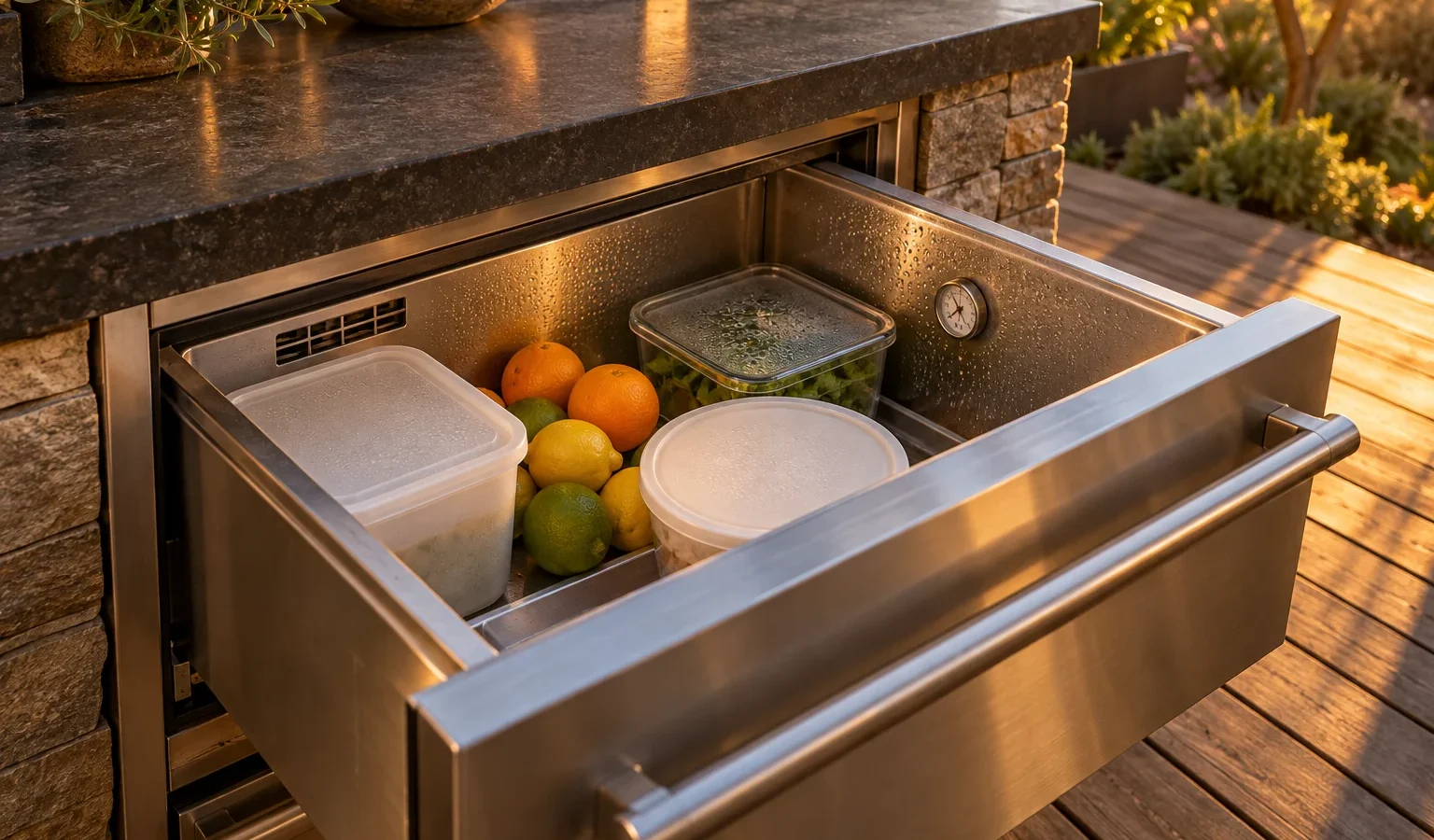
Refrigerated drawers are popular in outdoor kitchens because they sit low in the island, hold drinks and marinated food, and keep everything within reach of the grill. They also work harder than an indoor unit. A drawer built into a sunny deck island, or into a cabinet sealed on three sides, can struggle to shed heat even when nothing is broken.
Before assuming a fault, think about what changed. Did you load a large amount of warm drinks for a party? Was the drawer left ajar overnight? Did the weather turn hot or the sun swing around to hit the island? A drawer that has just been restocked needs time to pull everything down, and a few hours is normal. If it is still mild the next morning, or the contents slowly warm over several days, something is wrong.
A sealed system moves heat out of the drawer. A compressor pushes refrigerant around, an evaporator inside the drawer absorbs the heat, and a condenser at the back or underneath releases it into the surrounding cabinet. Small fans pull air across those coils. If any link is blocked, dirty or stopped, the drawer warms up. That is why airflow around an outdoor unit matters as much as the electronics.
One controlled power reset is acceptable: switch off at the breaker, wait briefly, and restore. Do not repeat it over and over, because repeated restarts strain the compressor.
Do not remove the kickplate to vacuum the condenser unless the manual for your unit shows it as an owner task. Do not chip ice or frost with a sharp tool, never touch the sealed refrigeration lines, and do not bypass the control with extension cords or adapters. Keep food that has been warm for a long time out of the equation: if it sat warm for a long stretch, it is safer to discard than to guess.
Outdoor refrigeration from DCS comes in several forms, including drawers such as the RF24DE4 and hinged refrigerators and beer dispensers in the same 24-inch family. The label is usually inside the drawer cavity wall or behind the kickplate. A technician who knows the exact model arrives knowing the fan, thermistor and control layout. The DCS refrigerator guide lists the lineup.
Diagnosis comes first. The technician checks airflow around the cabinet opening, the state of the condenser, the fan operation, the thermistor readings and the control behavior over time. You then receive a written estimate, and nothing is repaired until you approve it. The overall approach is described on the DCS refrigerator repair page.
Stop relying on the drawer for perishable food as soon as it is clearly warm. Move the contents to another refrigerator, and switch the unit off at the breaker if you hear a loud buzzing, smell something burning, or see water pooling near the outlet. Related cases: our article on an outdoor fridge that is too warm covers the hinged units.
If a gathering is coming and the drawer is not ready, plan around it rather than hoping. Move drinks and perishables to a cooler with ice or another refrigerator, and leave the drawer shut so any residual cold stays inside while you work through the checks. Keep a short log: the time you found the problem, what the display showed, what you changed, and how it behaved afterward. That log shortens the diagnosis, because intermittent cooling faults are much easier to find when the pattern is known.
Keep the front grille free, do not stack boxes against the island opening, and wipe the gasket when you clean up after a cookout. Open the drawer only as long as you need to, and avoid loading hot items straight from the sun. In foggy months, check the GFCI outlet now and then, since a nuisance trip quietly turns a cold drawer into a warm one.
Several hours is normal for a heavy load of warm items. If the drawer is still mild the next morning, the problem is more than loading.
Yes. Near the ocean and the Bay, salt and fog can coat the condenser and corrode connections, which reduces cooling over time. A technician checks for this.
E2 relates to the condenser fan motor. You can check airflow and the power supply, but the fan itself needs a technician to inspect and replace.
If perishable food sat warm for a long time, discard it. Do not rely on smell or look to decide.
Yes. A cut-out with too little ventilation traps heat. The technician checks the opening along with the unit.
Share a few details and we’ll confirm an appointment. Prefer to talk? Call us and we’ll help right away.