

Specialized DCS Appliance Repair in San Francisco
Mon–Sat: 8:00 AM – 7:00 PM
Water under or around a DCS DishDrawer needs prompt attention. See likely sources, what to shut off, which checks are safe, and when to call.
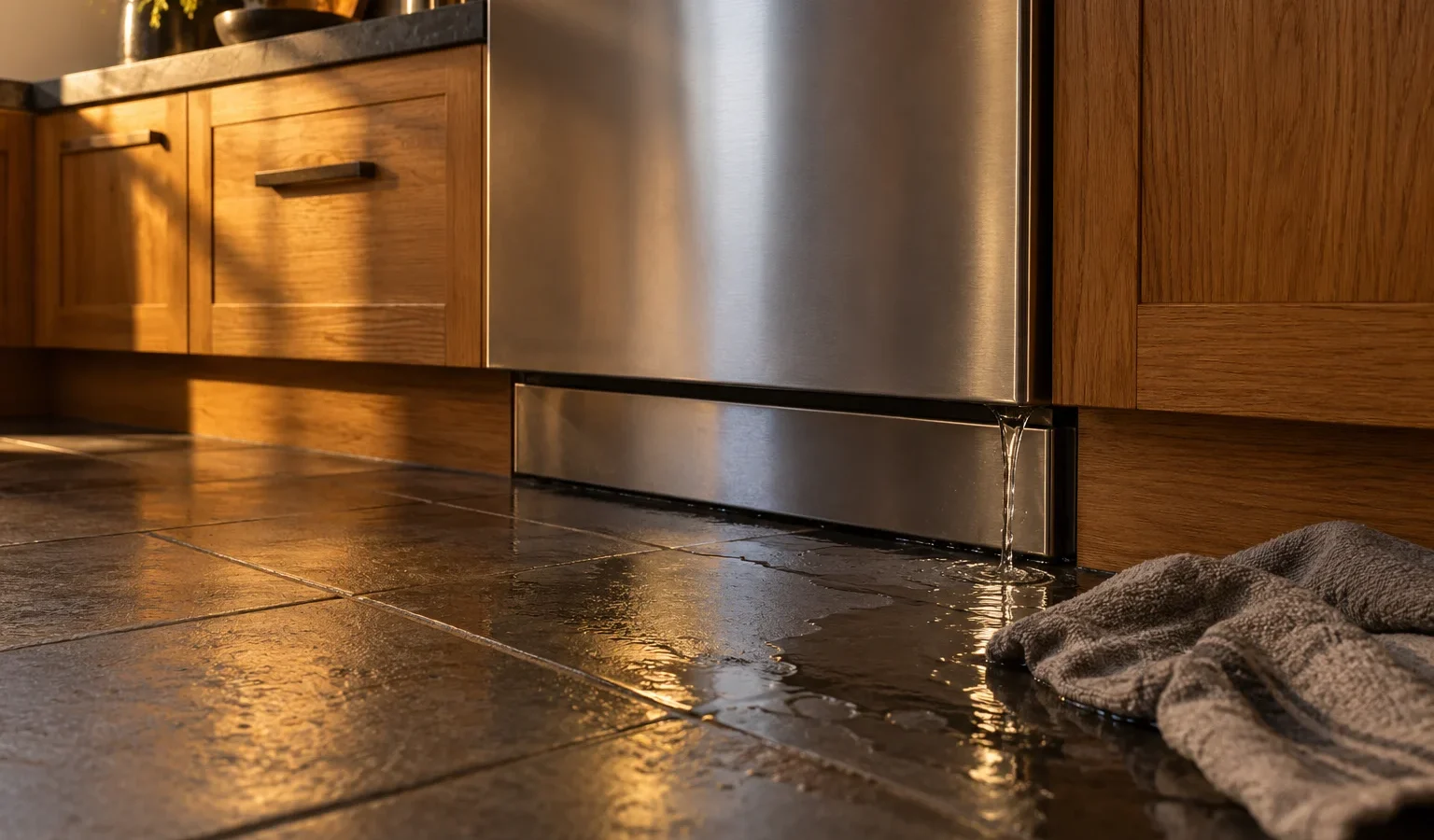
A puddle by the dishwasher can come from many places, and only a few of them are the dishwasher. A good first move is to stop the water, protect the cabinet and floor, and gather clues. Sorting the source helps us arrive with the right information, and it spares you from repeating a cycle that makes damage worse.
Switch off the dishwasher at its breaker or unplug it if you can reach the plug safely and dry. Close the water supply valve beneath the sink if the leak seems to be continuous. Soak up standing water with towels, and move anything stored under or beside the unit. Do not run another cycle to “see if it still leaks”. A DishDrawer that shows the flood code F1 has told you the flood switch activated; the F1 page covers that meaning.
Before blaming the DishDrawer, look at the sink trap, the faucet connections and the disposer. Water that runs along a pipe and drips at the dishwasher location misleads many owners. Run the sink alone for a minute, with the dishwasher off, and watch.
The inlet hose and valve sit at the side or back and can drip at the fitting. A leak that appears even when the dishwasher is idle, and stops when the supply valve is closed, points to this area. Tightening anything is a job for a technician; a slightly overtightened fitting can crack.
The drain hose runs to the sink drain or disposer. A loose clamp, a kinked hose, or a clogged disposer inlet can send water back and over. Leaks that appear only while the unit is draining suggest this. Our related guide on a DishDrawer that will not drain explains clogs in more detail.
Each drawer closes against seals designed to keep water in. If a gasket is folded, torn, or dirty, spray can escape at the front during the wash. Oversized items, a basket placed wrong, or a plate leaning against the spray arm can also splash water out. Leaks that show along the front edge usually relate to seals or loading.
A cracked pump housing, a failed seal on a pump, or a loose internal hose lets water collect beneath the tub. Such leaks appear at the bottom of the unit and may be slow. The flood switch is there to catch exactly this.
Too much detergent, or the wrong kind, creates suds that push out through seals and vents. This sort of leak smells soapy and leaves residue. It is easy to test by using a measured amount of detergent next time.
DishDrawers sit in a cabinet cut-out with a water line, a drain line and an electrical connection nearby. If the unit was moved, if the cabinet shifted, or if a remodel tightened the cavity, hoses may be crushed and fittings strained. In Bay Area homes with older plumbing under sinks, corrosion at valves is another culprit. Where the unit has a high-loop or an air gap for the drain, a clog there leads to water rising and escaping at the wrong place. Leave plumbing adjustments to a technician.
If the cabinet floor around the unit is wet and any electrical part could have been in contact with water, keep the breaker off until the unit has been looked at.
DishDrawers come in single and double versions, plus an older 24-inch dishwasher in the lineup. Our list includes the DD24DCTB9 DishDrawer and the DW-24SS dishwasher. Their hose routing and seals differ, so please share the model number, which is usually on the drawer’s front edge or inside the frame.
While a visit is arranged, keep the water supply to the unit closed and the breaker off, and lay a towel or a shallow tray where a drip might form. Check the cabinet floor each morning and again at night. If you have a dishwasher beside a refrigerator or an electrical outlet, keep cords away from damp areas. In older buildings, notify the property manager or neighbor below if water might travel through the floor, so a small problem does not become a dispute. Photographs of the wet area and of the display help when you describe the situation to us.
Book when a leak is confirmed, even a slow one. Tell us when it happens in the cycle, where you see the water, and any code. We diagnose before repair, give you a written estimate and do nothing without your approval. Details of our dishwasher work are on the DCS dishwasher repair page, with the lineup in DCS dishwasher drawers. For a specific unit, see the DD24DCTB9.
Yes. Even a slow leak soaks the cabinet floor and can spread under flooring. Shut off the water and call.
It is better not to. A small leak is often an early warning of something bigger, and water near electrical parts is a risk.
A hose leak tends to appear at the back or side and may happen at fill or drain. A seal leak shows up at the front during the wash.
It can cause suds to push out. If water is soapy and the leak disappears with less detergent, that is your answer.
Where the water appears, when in the cycle, whether a code showed, and the model number from the label.
Share a few details and we’ll confirm an appointment. Prefer to talk? Call us and we’ll help right away.