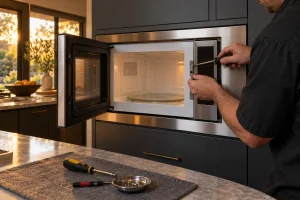
DCS Built-In Microwave Repair
DCS built-in and convection microwave ovens that run without heating, show sensor messages or will not latch, diagnosed safely from the opening…

Specialized DCS Appliance Repair in San Francisco
Mon–Sat: 8:00 AM – 7:00 PM
A combination appliance that works as both a microwave and a convection oven.

The CMO24SS is a convection microwave/oven, which means it contains two heating systems in one cavity. When it misbehaves, the first question is which side has failed.
We service it under DCS microwave repair, and the product range is shown at DCS microwaves.
Run a cup of water in microwave mode and observe whether it warms. Then try a convection setting and watch whether the cavity heats. If one mode works and the other does not, the fault is isolated to that system. Microwave energy involves a high-voltage section that only a technician should touch, while convection depends on an element and fan.
Lights, fan and turntable may all behave normally while the food stays cold. That pattern is covered in microwave runs but not heating. Please stop using the unit once you notice it and do not run it empty.
Combination ovens use sensors to track steam and temperature. When a sensor reading is off, the unit may stop or display a message. See microwave sensor error for how to describe it to us. Write the message down verbatim.
A built-in unit sits in a trim kit or cabinet cut-out with limited ventilation space. Items stored on top, or a blocked vent at the rear or top, raise internal temperature and shorten component life. In compact Bay Area kitchens, we also check that the outlet is a dedicated one and not shared with other loads.
Never open the casing. The label is usually on the door frame or the cavity wall. We diagnose, give a written estimate, and repair only with your approval.
Combination ovens exist in several forms, and the label tells us which of them you own. The CMO24SS number lets us look up its parts before the visit, including the door switches, the turntable drive and the convection fan. Please photograph the label and mention which cooking mode you use most, because the wear pattern of a heavily used convection fan differs from that of a unit used mainly for reheating. A short note about odd smells or sounds is welcome.
A fan and element circulate hot air, so it can bake or roast rather than just heat.
Metal, a damaged cavity coating or a food splatter on the waveguide cover can; stop using it and book a diagnosis.
Use the working mode lightly if it behaves safely, and book soon.
Usually on the door frame or inside the cavity wall.
Model-information disclaimer. Confirm your exact model number and specifications with your appliance documentation before booking a repair. Model pages are for identification and compatibility reference.
DCS built-in and convection microwave ovens that run without heating, show sensor messages or will not latch, diagnosed safely from the opening…
Share a few details and we’ll confirm an appointment. Prefer to talk? Call us and we’ll help right away.