

Specialized DCS Appliance Repair in San Francisco
Mon–Sat: 8:00 AM – 7:00 PM
A season-by-season checklist for DCS outdoor grills, refrigeration, ranges, DishDrawers and hoods, built around fog, salt air and rain in the Bay Area.
Professional-style appliances are built to be used hard, and they tolerate a lot. What they do not tolerate well is neglect that builds up quietly: grease in a burner port, lint on a refrigerator condenser, a dishwasher filter nobody has looked at in a year. In the Bay Area there is an extra layer. Fog settles on outdoor kitchens most mornings, salt air drifts well inland from the ocean and the Bay, and winter rain finds every gap in a grill cover. This checklist groups the upkeep by how often it makes sense and keeps every step on the outside of the appliance.
Everything below is surface care: wiping, clearing, looking and listening. Do not remove panels, do not touch gas fittings or the sealed refrigeration system, and do not bypass a switch or a latch to see what happens. If you smell gas, leave the area, avoid light switches, and call the gas utility or 911 from outside. With a propane grill, close the tank valve first and keep the lid open whenever you are working near the burners.
Keep a small notebook, or a note on your phone, with the model number of each appliance and the date you last did each task. A model number saved in advance saves a lot of back and forth later, and our guide on how to find a DCS model number shows the usual label spots.
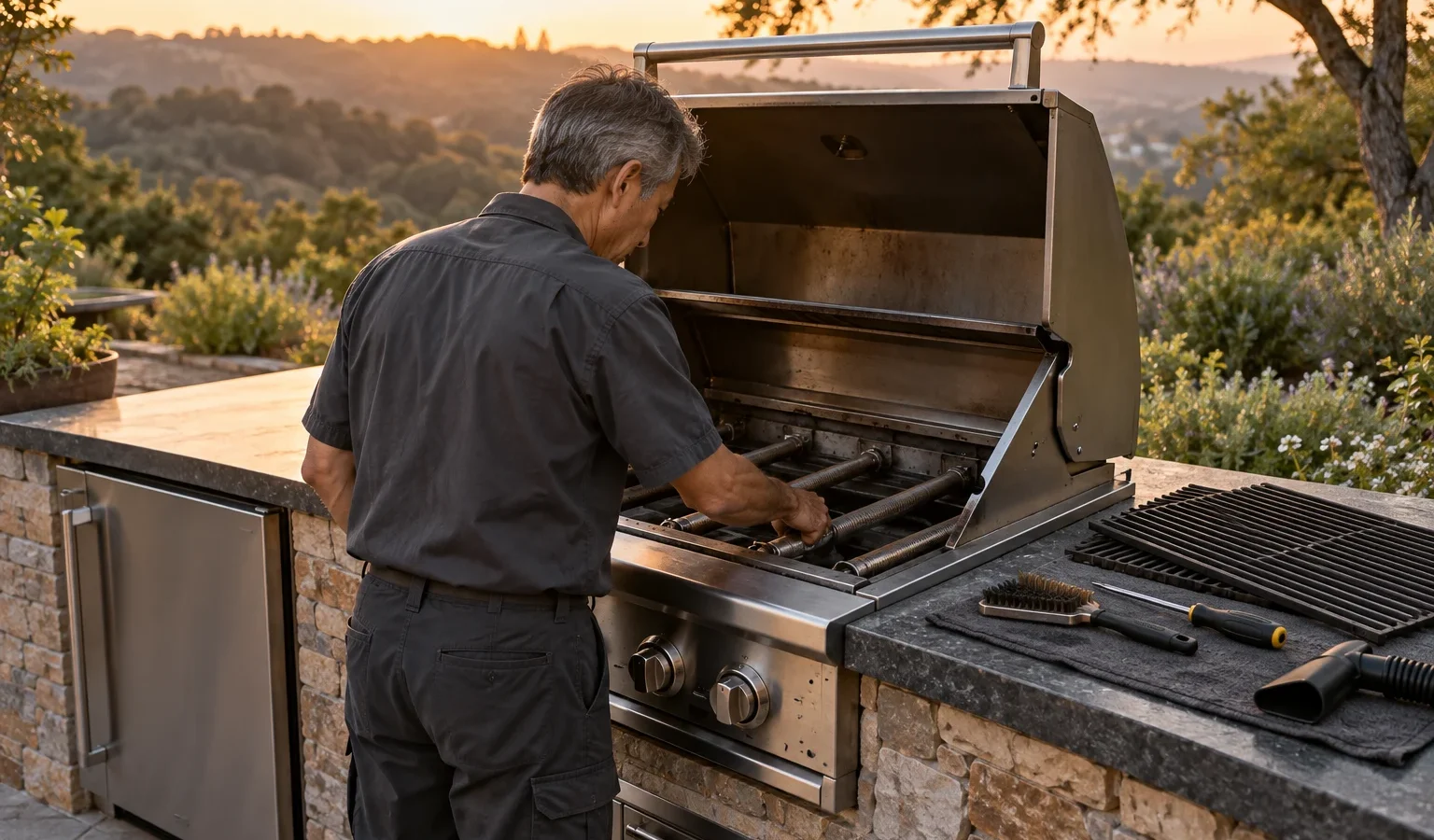
Outdoor grill. After the grates cool, brush off residue and empty the drip tray before grease turns to a hard film. Look at the burner ports for spider webs or crust; a blocked port is the usual start of a weak or lopsided flame. Close the lid on a dry day and cover the grill when it will sit through rain.
Refrigerator drawers and beverage chillers. Wipe the door gasket with warm water and dry it. A gasket that is clean seals better, and a sticky one lets warm air creep in. Check that nothing is blocking the air path around bottles and trays.
DishDrawer. Rinse plates only as far as needed, and glance at the filter area for labels, seeds or bits of glass after a big load. Leave the drawer slightly open overnight if it smells closed in.
Range and cooktop. Wipe up boil-overs once the surface is cool. Sugary spills baked into a burner cap or igniter area cause hard starts later.
Outdoor appliances meet moisture daily from autumn into spring. Wipe stainless surfaces with a soft cloth and a mild cleaner, always along the grain, to remove the salt film that sits on them after foggy nights. Check that grill covers are dry inside, because a damp cover on a warm grill traps humidity. Make sure the island’s ventilation openings are clear of leaves and spider nests; a built-in grill needs that air movement, and a blocked opening can cause poor performance and uneven heat.
Roof decks and hillside patios get gusts that can blow out a flame or push debris into burners. Look at wind guards or placement, and keep the propane tank upright, secure and with its valve closed when the grill is idle. If the grill runs on a natural gas line, note whether the shut-off valve is easy to reach and clearly marked.
Choose a calm week and go through the whole kitchen with a notebook. Does each burner light and settle into an even flame? Do refrigerators hold a steady, cold interior? Does the DishDrawer fill, wash and drain without noise you have not heard before? Does the oven door close flat? Does the hood pull smoke from the cooktop edge to the filters? Write down anything that has changed since last year. A new rattle or a slower start tells a technician a lot.
This is also the right time to book a diagnostic visit if you have been living with something odd. Appliances that feel merely quirky are often a step from a real failure, and a small fix is easier than a large one. You can start from the matching service page: DCS outdoor grill repair, DCS refrigerator repair, DCS dishwasher repair or DCS ventilation hood repair.
Cleaning solves dirt. It does not solve a failing part. Book a visit when a burner will not light even though the ports are clear, when a refrigerator keeps warming after the gasket and airflow are fine, when water appears under a DishDrawer, when you see rust that is spreading into structural pieces, or when any appliance shows a code that returns after one reset. We diagnose first, give you a written estimate, and repair nothing until you approve it.
Monthly is a sensible starting point for a home that cooks several times a week. If you sear, wok-cook or fry often, check them more often, because a grease-loaded filter restricts airflow and can drip.
It can. Fog carries salt a long way inland, and it lands on stainless steel, igniters and electrical contacts. Regular wiping and dry storage of covers slows the corrosion that causes slow starts and flaky controls.
Yes, as an observation exercise. Light every burner, listen, look and write things down. The repair side, anything involving panels, gas connections or sealed systems, belongs to a technician.
A breathable, well-fitted cover helps in rain and dust. Make sure the grill is cool and dry before covering, and take the cover off periodically so moisture does not collect underneath.
Usually on a label near the door frame, drawer edge, control panel, or inside the unit, depending on the appliance. The model number guide linked above covers the common spots.
Share a few details and we’ll confirm an appointment. Prefer to talk? Call us and we’ll help right away.