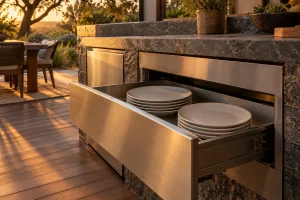
DCS Warming Drawers
Indoor and outdoor DCS warming drawers: lineup, where the label sits, typical heating complaints and the owner checks that are safe to…

Specialized DCS Appliance Repair in San Francisco
Mon–Sat: 8:00 AM – 7:00 PM
Indoor and outdoor drawers, from fog-damp patio cabinets to built-in stacks under a wall oven.
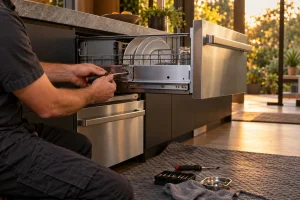
A warming drawer earns its place at the end of a long cook. It holds roasted vegetables, rolls and carved meat at serving condition while the rest of the meal comes together. When it stops doing that, the whole timing of a dinner falls apart. We diagnose and repair DCS warming drawers in San Francisco and across the Bay Area, whether the drawer sits under a wall oven in an indoor kitchen or in an outdoor cabinet run beside a built-in grill.
The control lights up, you select a setting, and the food stays cool. On most warming drawers the heating element, a temperature sensor and a thermal safety cutout all have to agree before heat is delivered. A technician checks the element for continuity, the sensor for a sensible reading and the cutout for a trip that never reset. A burned-out element and a tripped cutout look identical from the outside, so the check has to be done with instruments rather than by guessing.
Food warms at the back but not at the front, or the drawer takes far too long to come up to temperature. Common causes are a worn drawer gasket or a drawer that no longer closes squarely on its slides, which lets heat escape. A sensor that has drifted can also make the control cut heat early.
Dead keys, a display that flickers, or settings that change on their own usually point to the control board or its connection, sometimes to moisture that reached the electronics. Outdoor units are more exposed to that than indoor ones.
A drawer that sticks, drifts open or will not seat fully can be a slide problem, a bent bracket or something lodged in the track. Because the warmth control often depends on the drawer registering as closed, a mechanical fault can look like an electrical one.
Outdoor DCS warming drawers live in the same cabinetry as the grill, side burner and refrigeration, and that environment is hard on electronics. Fog and salt air near the ocean and the Bay settle on terminals and connectors, and winter rain can find its way into a cabinet that is not fully sheltered. We look for corrosion at the plug and the internal connections, for water stains under the cut-out, and for a drawer front that has swollen or warped enough to stop sealing.
The power supply matters just as much. An outdoor drawer should be on a protected outdoor outlet, and that outlet should not be shared with a heavy load such as a pellet smoker or a heater. If a GFCI keeps tripping, the cause may be moisture on the drawer wiring or on something else on the same circuit. A technician separates the two before replacing any part.
In professional-style indoor kitchens the drawer is often built in below a wall oven. That position is tight. The cut-out leaves little clearance for airflow, and heat from the oven above can raise the temperature around the control. Installation details we check include the width of the opening, whether the drawer sits level, how the power cord is routed behind it and whether anything has been stored in the gap. A drawer pushed hard against a wall can overheat its own cabinet and trip its safety cutout, which looks like a failed element.
Nothing is repaired until you have seen the diagnosis and said yes.
Do not open the panels, do not pull the drawer off its slides to reach the wiring, and do not test the element yourself.
Switch the drawer off and turn off its breaker if you notice a burning smell that lingers, smoke, sparks, melted plastic around the control or a GFCI that trips every time you use it. Keep the drawer closed and empty until it has been looked at. A warming drawer is meant to be low and steady; one that is clearly overheating food is a fault, not a feature.
The drawers we see range from outdoor models to indoor professional drawers, and they do not share every part. The label is usually behind the drawer front or on the cabinet frame once the drawer is pulled out, and an outdoor unit may carry it near the opening. A photo of the label, plus the width of the opening, lets us bring the right element, sensor or control to the first visit. Read about the lineup in our DCS warming drawer guide.
Examples that come through our schedule include the WD1-30-SSOD, a 30-inch outdoor warming drawer, and the WDVI30, a 30-inch Professional-series warming drawer. We also service the 27-inch outdoor WD-27-SS-OD and the 30-inch outdoor WD130SSOD.
We have no verified warming drawer code list to share. If your drawer shows a letter or number, write it down exactly with the setting you had selected and tell us at booking; it helps even when we do not repeat a meaning for it. Codes on other DCS appliances are collected in the error code index.
When you request a visit, tell us whether the drawer is indoor or outdoor, what it does and does not do, and the model if you can read it. We confirm a window, arrive, listen to the history and test before opening anything. If a part is needed, you receive the written estimate and decide. For a drawer that just will not warm, our troubleshooting article on a warming drawer not heating walks through what to note before you call. Everything else on our menu is on the services page.
Damp air and rain tend to leave moisture on connectors and the control. Check the GFCI first, then book a visit so the contacts and control can be dried and tested.
You can use it for non-critical items while you wait, but uneven warmth usually means a worn gasket, a drawer out of square or a drifting sensor. It is worth finding out which before it gets worse.
We would not recommend it. Warming drawers are made for serving, not storage, and an unattended fault is hard to catch.
Yes. We check the cut-out clearance and airflow around the drawer as part of the diagnosis, since heat from the oven above can mimic a fault.
No, but a photo of the label saves time. If the label is hidden, describe the drawer and its width and we will work from that.
Indoor and outdoor DCS warming drawers: lineup, where the label sits, typical heating complaints and the owner checks that are safe to…
DCS built-in and convection microwave ovens that run without heating, show sensor messages or will not latch, diagnosed safely from the opening…
A burner that will not spark, clicks nonstop or burns with a ragged flame deserves a proper look. We repair DCS gas…
Drain, leak, lid and fill faults on DCS DishDrawer units and the 24-inch dishwasher, diagnosed before repair, with a written estimate for…
Repair for DCS outdoor ice makers in San Francisco and the Bay Area: no ice, slow ice, flashing lights and water line…
Share a few details and we’ll confirm an appointment. Prefer to talk? Call us and we’ll help right away.