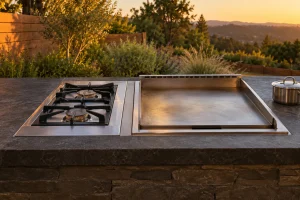
DCS Side Burners and Griddles
Outdoor DCS side burners, double side burners, griddles and the power burner: what is in the lineup, where labels sit and how…

Specialized DCS Appliance Repair in San Francisco
Mon–Sat: 8:00 AM – 7:00 PM
A side burner that won't light or a griddle with cold spots? We find the cause and give you a written estimate to approve first.
Side burners, griddles and the power burner are where an outdoor kitchen gets its fast cooking: a pot of stock on a double side burner, a flat-top breakfast on a griddle, a hard sear on a wok-style power burner. They sit closest to the splash zone, take the most grease, and are the first parts to show wear from fog and rain. We repair DCS side burners, double side burners, griddles and power burners across San Francisco and the Bay Area, diagnosing before any repair and writing down an estimate you approve first.
A side burner that needs several tries, or that lights only on one of two burners, is telling you something about the spark path or the gas path. We look at the electrode, its wiring and the module behind it, and then at the burner ports and the supply. Wet mornings on a deck can cause a light-up delay that vanishes once the area dries, which is a clue worth passing on. Our guide on a side burner that won’t light shows what to note before you book.
Yellow tips, a ragged ring or a flame that roars and lifts away from the burner can come from blocked ports, a gas and air mix that has shifted, or a regulator that is not holding steady. Cooking spills that boil over into the burner are an everyday cause on a busy patio.
If a griddle plate heats unevenly, we consider the burner beneath it, the plate itself, and how the unit is leveled in the cabinet. Grease that has been allowed to pool or carbonize on the plate also changes how heat spreads. A plate that has warped or has lost its seasoning layer in places is something we point out in the estimate.
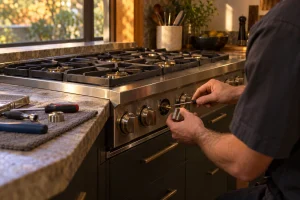
A knob that spins without engaging, feels rough, or leaves the flame stuck high or low can mean a worn valve stem or a build-up of grease behind the panel. Corroded fittings on a unit that sits in a damp island are another cause.
A power burner pushes more heat than a standard burner, and it expects a steady supply and clear air passages. When it sputters or will not hold a high flame, we look closely at fuel delivery, the burner head and the surrounding cutout.
The order follows the path the gas takes. We confirm fuel supply and regulation, observe how each burner behaves with the knob in different positions, inspect the ports and the spark components, and check the griddle plate and cabinet fit where one applies. We explain what we found, give you a written estimate for the repair, and wait for your approval. Nothing is changed before then.
Side burners and griddles are set into countertops and islands, and the cutout size and the ventilation openings in the cabinet below affect how they burn. Blocked vents or stuffed storage can crowd the unit from underneath. We check clearances as part of a visit and mention what we see.
Most units are supplied for liquid propane, shown by the trailing -L in the model name, and some yards use a natural gas line. A burner running on the wrong orifice for its fuel will behave poorly, so we ask which fuel you have and whether it has been converted.
Ocean air creates corrosion, rain splashes into open burner wells, and wind on a roof deck makes a low flame hard to keep alive. A fitted cover protects, though standing moisture under it does not help, and we look for signs of that.
Do not disassemble burners, bend electrodes or tighten any gas fitting.
Any gas smell means leaving the area at once, touching no switches, and calling the gas utility or 911 from outside. On propane, close the tank valve first if it is safe to do so. Do not use a match near a burner that failed to light, and do not relight after you smelled gas. If a burner flames outside its well or you see damage to hoses or wiring, stop cooking on it and book a diagnosis.
The model number fixes the size, the type and the fuel, and so it fixes the parts. It is usually located under the control panel or on the firebox or drip-tray area. If you are unsure, our guide to finding the model number is short. As examples of how it reads, BFGC-30BGD-L is a griddle and double side burner in Series 7, GDE1-30-L is a Series 9 griddle, and PBE1-24-L is a Series 9 power burner.
Send a request on the contact page with the model number, the fuel and what the burner does. We agree a time at your address in the city or elsewhere in the Bay Area, look over the unit and its cutout, explain the cause, and prepare the written estimate. With your approval the repair goes ahead and we test the burners in use before we finish.
The DCS side burner and griddle guide lays out the range. Model pages with specifics include the BFGC-30BGD-L, the GDE1-30-L and the PBE1-24-L. For the main grill beside your burner, see DCS grill repair.
The two burners on a double unit have separate electrodes, ports and valves, so a fault at one leaves the other working. A blocked port, a wet electrode or a worn valve are typical. A technician checks each path in turn.
Not necessarily. The cause may be the burner underneath, how the unit is leveled in the island, or grease built up on the plate. We check all three before suggesting anything.
A persistent yellow or ragged flame suggests the air and gas mix is off, and it can leave soot and grease on cookware. Stop using that burner until it has been looked at.
Yes. Power burners, side burners, double side burners and griddles from DCS are all within what we repair.
An adult who can approve the estimate should be reachable. We explain findings before anything is repaired, so nothing proceeds without approval.
Outdoor DCS side burners, double side burners, griddles and the power burner: what is in the lineup, where labels sit and how…
DCS built-in and convection microwave ovens that run without heating, show sensor messages or will not latch, diagnosed safely from the opening…
A burner that will not spark, clicks nonstop or burns with a ragged flame deserves a proper look. We repair DCS gas…
Drain, leak, lid and fill faults on DCS DishDrawer units and the 24-inch dishwasher, diagnosed before repair, with a written estimate for…
Repair for DCS outdoor ice makers in San Francisco and the Bay Area: no ice, slow ice, flashing lights and water line…
Share a few details and we’ll confirm an appointment. Prefer to talk? Call us and we’ll help right away.